
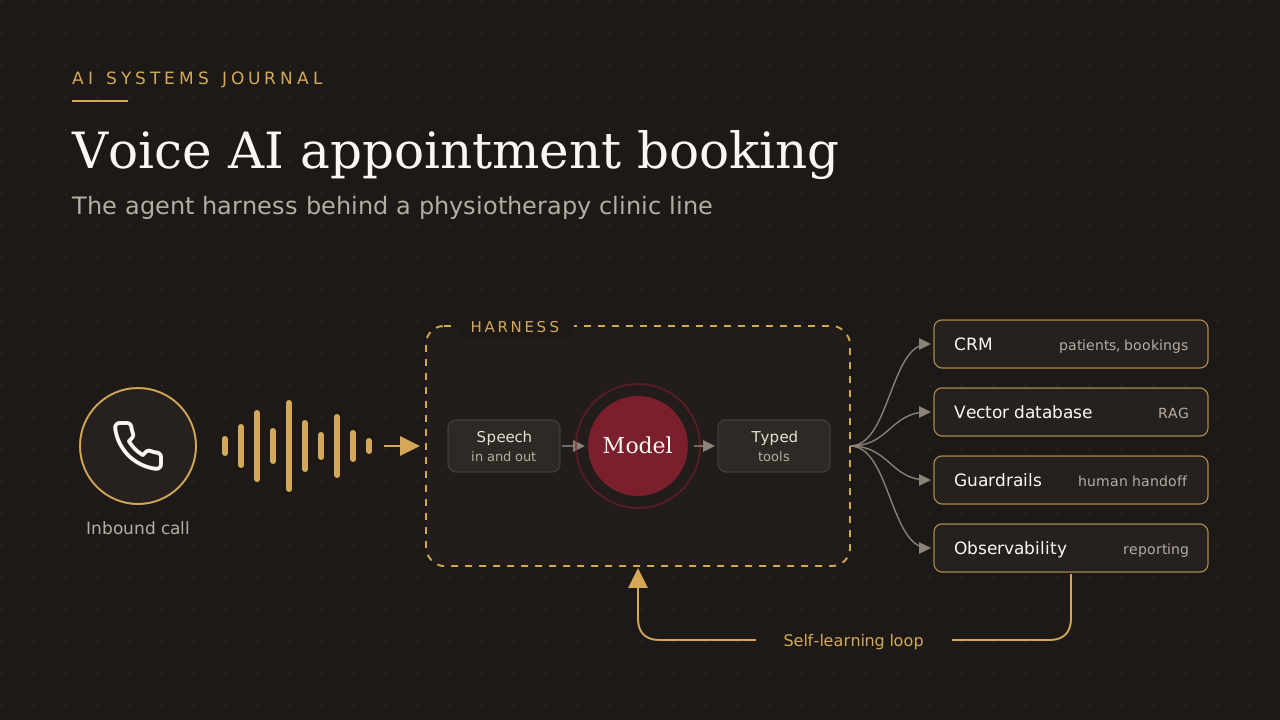
A physiotherapy clinic loses a booking every time the phone rings while the front desk is with a patient. An inbound voice AI agent, often sold as an AI receptionist, can answer every call and book the appointment, but only when the model sits inside a harness: typed tools into the CRM, retrieval from a vector database, clinical guardrails, and a feedback loop that turns each call into an improvement.
I design and build voice AI agents that book appointments and qualify leads. This post is the blueprint I use for voice AI appointment booking in a physiotherapy clinic: the call flow, the CRM integration, where RAG fits, how the self-learning loop works, and what to measure.
What is a voice AI agent harness?
A voice AI agent harness is everything around the language model that turns a phone conversation into a controlled action. It covers telephony, speech-to-text and text-to-speech, the tools the agent can call, the knowledge it can retrieve, the guardrails on what it may say, and the tracing that records each call. The shorthand is the same as for any agent: agent = model + harness.
I covered the general pattern in agent harness engineering. A voice harness adds four constraints a text agent does not have:
- A latency budget.A caller hears silence as a fault. I design for roughly one second from the end of the caller's speech to the start of the reply, which limits how much context, retrieval and tool work fits in one turn.
- Turn-taking. Callers interrupt, pause and talk over the agent. The harness has to stop speaking when interrupted and keep the conversation state intact.
- Speech errors. Names, dates and phone numbers are misheard. Anything that will be written to a record must be read back and confirmed.
- No screen. The caller cannot see three slots side by side. The agent offers two options at a time and confirms the choice aloud.
Why is physiotherapy appointment booking a good inbound voice AI use case?
Physiotherapy booking suits inbound voice AI because the calls are frequent, repetitive and time-sensitive, and the people who could answer them are busy treating patients. Most calls fall into a handful of intents, a course of treatment means repeat bookings, and a missed call usually becomes a booking at another clinic.
The agent's scope is deliberately narrow. It books, moves and cancels appointments and answers clinic questions. It does not assess, diagnose or advise on treatment.
| Caller intent | What the agent does | Harness component that does the work |
|---|---|---|
| New patient booking | Captures name, reason for visit and preferred times; offers slots; books | CRM tools, calendar tool |
| Follow-up booking | Recognises the caller, finds their practitioner, offers the next slots | CRM lookup by caller ID |
| Reschedule or cancel | Finds the existing appointment, applies the cancellation policy, rebooks | CRM tools, policy retrieval |
| Clinic question (price, insurance, location, what to bring) | Answers from the clinic's own documents | Vector database and RAG |
| Clinical question ("should I ice it?") | Declines to advise, offers a callback from a physiotherapist | Guardrails, callback tool |
| Urgent symptoms | Tells the caller to seek urgent care and transfers to a person | Guardrails, human handoff |
How does an inbound voice AI call flow through the harness?
One inbound call passes through six harness layers: telephony, the speech pipeline, the model, tools, retrieval and tracing. The model decides what to say and which tool to call; every other step is harness code that I can test, version and monitor.
- The call arrives.The clinic's number forwards to the voice platform, either always or only after hours and on overflow.
- The agent discloses and looks up. It says it is an AI assistant and that the call is recorded, then looks the caller up in the CRM by phone number.
- The agent identifies the intent. Booking, change, question or something it must hand off.
- Questions go to retrieval. The harness searches the vector database and gives the model only the matching clinic passages.
- Bookings go to tools. The agent asks the calendar for open slots, offers two, reads the choice back and writes the booking to the CRM.
- Anything out of scope goes to a person. The agent transfers the call during opening hours or creates a callback task outside them.
- The call is closed out. The harness writes a summary and outcome to the CRM and sends a confirmation by SMS or WhatsApp.
- The call is traced and scored. The transcript, tool calls, latency and cost go to the observability layer and feed the learning loop.
| Harness layer | Job | Typical tools |
|---|---|---|
| Telephony | Receives the call, forwards and transfers | Clinic phone number, SIP or call forwarding |
| Voice platform | Speech-to-text, turn-taking, text-to-speech, the agent loop | Vapi with a chosen LLM, STT and TTS |
| Orchestration | The only path between the agent and other systems; logs and retries | n8n webhooks |
| System of record | Patients, appointments, call history | CRM or the clinic's practice-management system |
| Knowledge | Clinic facts the agent may quote | Qdrant or pgvector, with hybrid search |
| Observability | Traces, evals, cost and latency | Langfuse, plus dashboards on CRM data |
The orchestration rule is the same one I use in the voice AI lead generation platform architecture: no component talks to another directly, so every data movement is logged and can be replayed. For outbound marketplace sales instead of inbound booking, see the multilingual voice sales agent case study.
How do you connect a voice AI agent to a CRM?
Connect a voice AI agent to a CRM through a small set of typed tools exposed by an orchestration layer, never through direct CRM credentials. The CRM stays the system of record for patients and appointments. The agent can only do what its tools allow, and each tool call is validated, logged and safe to retry.
| Tool | When the agent calls it | What the harness enforces |
|---|---|---|
lookup_patient | Start of every call, by caller ID | Returns only name, practitioner and next appointment |
get_available_slots | Caller wants to book or move | Live calendar query; filtered by service, practitioner and location |
book_appointment | After the caller confirms a read-back | Idempotency key so a retry cannot double-book |
reschedule_appointment | Caller wants a different time | Checks the cancellation policy window first |
cancel_appointment | Caller wants to cancel | Same policy check; frees the slot |
create_callback_task | Clinical question or after-hours handoff | Assigns to the right team with the call summary |
transfer_to_human | Urgent symptoms, distress, or the caller asks | Always available; never blocked by the prompt |
log_call_outcome | End of every call | Fixed outcome codes, so reports stay consistent |
Four rules keep the CRM clean:
- Read back before every write."Tuesday the 18th at 4:30 pm with Priya, is that right?" comes before
book_appointment, every time. - Make writes idempotent. Voice platforms retry tool calls on timeouts. Without an idempotency key, a slow CRM produces duplicate bookings.
- Return the minimum.The model sees the fields it needs for this call, not the patient's full record.
- Use fixed outcome codes. Booked, rescheduled, cancelled, answered, callback, transferred, abandoned. Free-text outcomes cannot be reported on.
Where do the vector database and RAG fit in a voice AI agent?
The vector database holds the clinic's static knowledge, and RAG (retrieval-augmented generation) passes the model only the passages that answer the caller's current question. Retrieval keeps the prompt short, which protects latency, and it keeps answers tied to the clinic's own documents instead of the model's general knowledge.
The design decision that matters most is what does not go in the vector database:
| Knowledge | Where it lives | Why |
|---|---|---|
| Services, prices, session lengths | Vector database | Changes rarely; quoted word for word |
| Insurance, payment and cancellation policies | Vector database | Must match the written policy |
| Practitioner profiles and specialisms | Vector database | Helps match a caller to the right physiotherapist |
| Location, parking, what to bring | Vector database | Classic repeat questions |
| Appointment availability | Calendar, via tool call | Changes by the minute; a stale answer is a wrong booking |
| Patient details and history | CRM, via tool call | Personal data stays in the system of record |
Retrieval settings I use for voice:
- One chunk per question or policy. Short, self-contained passages read well aloud and retrieve cleanly.
- Metadata on every chunk. Clinic location, service, language and a valid-until date, so an expired price list is filtered out before the model sees it.
- Hybrid search.Keyword plus vector search catches exact terms such as an insurer's name that embeddings alone can miss.
- Three passages at most. More context adds latency and gives the model more to wander into.
- A defined "no answer" path. If nothing relevant is retrieved, the agent says it does not have that information and offers a callback. Each miss is logged as a knowledge gap.
For the retrieval layer itself, see vector databases for semantic search.
What guardrails does a healthcare voice AI agent need?
A healthcare voice AI agent needs harness-level guardrails, not prompt-only rules. Enforce a hard boundary on clinical advice, an escalation path for urgent symptoms, disclosure and consent at the start of the call, and privacy controls on every system that touches patient data. A prompt instruction can be talked around; a harness rule cannot.
- No clinical advice. The agent books and informs. Questions about symptoms, exercises or medication get one answer: a physiotherapist will call back.
- Urgent-symptom escalation.The clinic's clinical lead supplies the list of red-flag phrases. On a match, the agent tells the caller to seek urgent care and transfers to a person. The clinic owns that list, not the engineer.
- Disclosure and consent. The agent says it is an AI assistant and that the call is recorded before it collects anything.
- A human is always reachable."Can I speak to someone?" triggers a transfer or a callback on the first ask.
- Privacy by vendor.Call audio and transcripts are patient data. In the US, HHS guidance says a clinic may use a cloud service for electronic health information only with a HIPAA-compliant business associate agreement in place. That covers the voice platform, the model provider, the transcription service and the tracing tool. Elsewhere, check GDPR or India's DPDP Act. This is an engineering view, not legal advice.
- Redacted traces. Names, phone numbers and dates of birth are masked before transcripts reach the observability tool.
What is a voice AI self-learning loop?
A voice AI self-learning loop is a closed process that scores every call, groups the failures, proposes fixes to the knowledge base, prompt and tools, and releases those fixes after human review and a regression test. The model's weights never change. What learns is the harness, and each fix keeps working when the model underneath is upgraded.
- Capture. Every call produces a recording, a transcript, the tool calls with their results, timings and a fixed outcome code.
- Score. An LLM judge grades each transcript against a rubric: was the intent handled, was the booking read back, did every stated fact come from a retrieved passage, was the clinical boundary kept.
- Cluster. Failures are grouped by cause, because each cause has a different fix.
- Propose. The loop drafts the fix: a new knowledge-base entry, a prompt edit, a clearer tool description or a pronunciation entry.
- Review. A person approves or rejects each proposal. The clinic manager owns knowledge; the engineer owns prompt and tools.
- Regress. The new version replays a golden set of call scenarios with simulated callers. A fix that breaks a passing scenario does not ship.
- Release and watch. Prompt and knowledge base are versioned, so every metric can be compared by version and rolled back.
| Failure cluster | Signal in the data | Fix the loop proposes |
|---|---|---|
| Knowledge gap | Retrieval returned nothing; agent offered a callback | Draft knowledge-base entry for the clinic to approve |
| Misheard entity | Caller corrected a name, date or number | Pronunciation or keyword hint; stricter read-back |
| Tool failure | Timeout or validation error from the CRM | Schema fix, retry policy or a clearer tool description |
| Conversation drop-off | Caller hung up at the same step repeatedly | Shorter prompt for that step; fewer questions before offering slots |
| Avoidable handoff | Transferred a call the agent could have handled | New intent, tool or knowledge entry |
Two rules keep the loop safe. Nothing reaches production without a named approver, because an agent that edits its own instructions unreviewed will drift. And every failed call that gets fixed becomes a permanent test case, so the golden set grows with the clinic's real traffic.
What should you measure for voice AI agents?
Measure clinic value and call failures from the same call record: reporting answers whether the agent is worth it, and observability answers why a call went wrong. Join both views by one call ID that appears in the voice platform, the trace and the CRM.
| Audience | Metric | What it tells you |
|---|---|---|
| Clinic owner | Calls answered, by hour | Demand the front desk was missing, especially after hours |
| Clinic owner | Booking conversion rate | Share of booking-intent calls that end in an appointment |
| Clinic owner | Containment rate | Share of calls resolved without a person |
| Clinic owner | Handoff rate, by reason | Where the agent's scope should grow next |
| Clinic owner | No-show rate for AI-booked appointments | Whether the bookings are real |
| Clinic owner | Cost per booking | All-in call cost divided by appointments booked |
| Engineer | Latency per turn, p50 and p95, split by STT, LLM, TTS and tools | Which stage is making callers wait |
| Engineer | Tool error rate, per tool | CRM and calendar reliability |
| Engineer | Retrieval miss rate | How often the knowledge base had no answer |
| Engineer | Interruption rate | Replies that are too long or too slow |
| Engineer | Eval score, by prompt and knowledge-base version | Whether the last release helped |
In practice:
- Trace every call end to end. One trace per call in Langfuse, with a span for each model turn, retrieval and tool call, and the cost attached.
- Build the owner's dashboard from CRM data. Outcome codes written by
log_call_outcomeare the source, so the numbers match what staff see in the CRM. - Alert on three things. A spike in tool errors, p95 latency over budget, and a drop in booking conversion against the trailing week.
- Price by the all-in minute.Platform fee plus LLM, speech-to-text, text-to-speech and telephony. The platform's headline rate is only one part.
What I'd do: the build order for a clinic voice agent
Start with after-hours and overflow calls, one location and three intents, and add scope only when the data from the learning loop asks for it. After-hours calls are the lowest-risk place to begin: the alternative is voicemail, so every booking is a gain and staff workflows do not change.
- Launch narrow. New booking, follow-up booking and clinic questions, with handoff for everything else. Write the evals and the golden call set before the first live call.
- Add changes. Reschedule and cancel, once the cancellation policy is in the knowledge base and the idempotent tools have proved reliable.
- Go full-time. Answer daytime calls first-ring or on overflow, with warm transfer to the front desk.
- Extend outward. Appointment reminders and rebooking of lapsed treatment plans use the same tools and knowledge base.
Three decisions I would make early:
- Buy the voice loop, build the harness. A managed voice platform gives you turn-taking and the speech pipeline. The tools, knowledge base, guardrails and learning loop are where the clinic-specific value sits.
- Keep the model swappable.Prompt, tools and knowledge live outside the voice platform's configuration and under version control, so changing the model or the vendor is a configuration change.
- Give the clinic the knowledge base. Staff should be able to correct a price or a policy without an engineer. The review step in the learning loop is their interface.
For multi-step agent logic beyond a single call, see agentic AI systems architecture with LangGraph.
Frequently asked questions
What is an AI harness in voice AI?
An AI harness is the software around the language model that lets it act safely: telephony, speech-to-text and text-to-speech, typed tools, retrieval, guardrails, state and tracing. In voice AI the harness also manages latency, interruptions and read-back confirmation. The model supplies the reasoning; the harness controls what the agent can know and do.
Can a voice AI agent book physiotherapy appointments?
Yes. An inbound voice AI agent can identify the caller, check live availability, offer slots, confirm the choice aloud and write the booking to the clinic's CRM or practice-management system. It should not give clinical advice; symptom questions are routed to a physiotherapist by transfer or callback.
Is a voice AI booking agent the same as an AI receptionist?
Largely, yes. AI receptionist is the common name for an inbound voice AI agent that answers the business line, handles questions, books appointments and hands off to staff. The difference is depth: a basic receptionist product takes messages and books into a calendar, while the agent in this post writes to the CRM through typed tools, retrieves clinic knowledge with RAG, and is traced and scored on every call.
Why does a voice AI agent need a vector database and RAG?
A vector database stores the clinic's services, prices and policies as searchable passages. RAG retrieves the few passages that match the caller's question and gives only those to the model. Answers stay grounded in the clinic's documents, the prompt stays short enough for a fast reply, and staff can update knowledge without changing the prompt.
Does a self-learning voice AI agent retrain itself on calls?
No. In a production self-learning loop the model is not retrained. Calls are scored automatically, failures are clustered, and the system proposes changes to the knowledge base, prompt and tools. A person approves each change and a regression suite runs before release.
What metrics matter for an inbound voice AI agent?
For the business: calls answered, booking conversion rate, containment rate, handoff reasons and cost per booking. For engineering: latency per turn at p50 and p95, tool error rate, retrieval miss rate, interruption rate and eval scores by version.
Is a voice AI agent for a clinic HIPAA compliant?
Compliance depends on the whole deployment, not the agent alone. In the US, each vendor that handles call audio, transcripts or patient records needs a business associate agreement with the clinic, alongside access controls, encryption and audit logs. Confirm the requirements with the clinic's compliance adviser.