
Voice AI · Lead Generation · n8n
Voice AI lead generation platform architecture
Architecture of a multi-client AI lead generation platform: data intake, enrichment, CRM, n8n orchestration, Vapi voice agents, WhatsApp, email and Slack.

· 6 min read
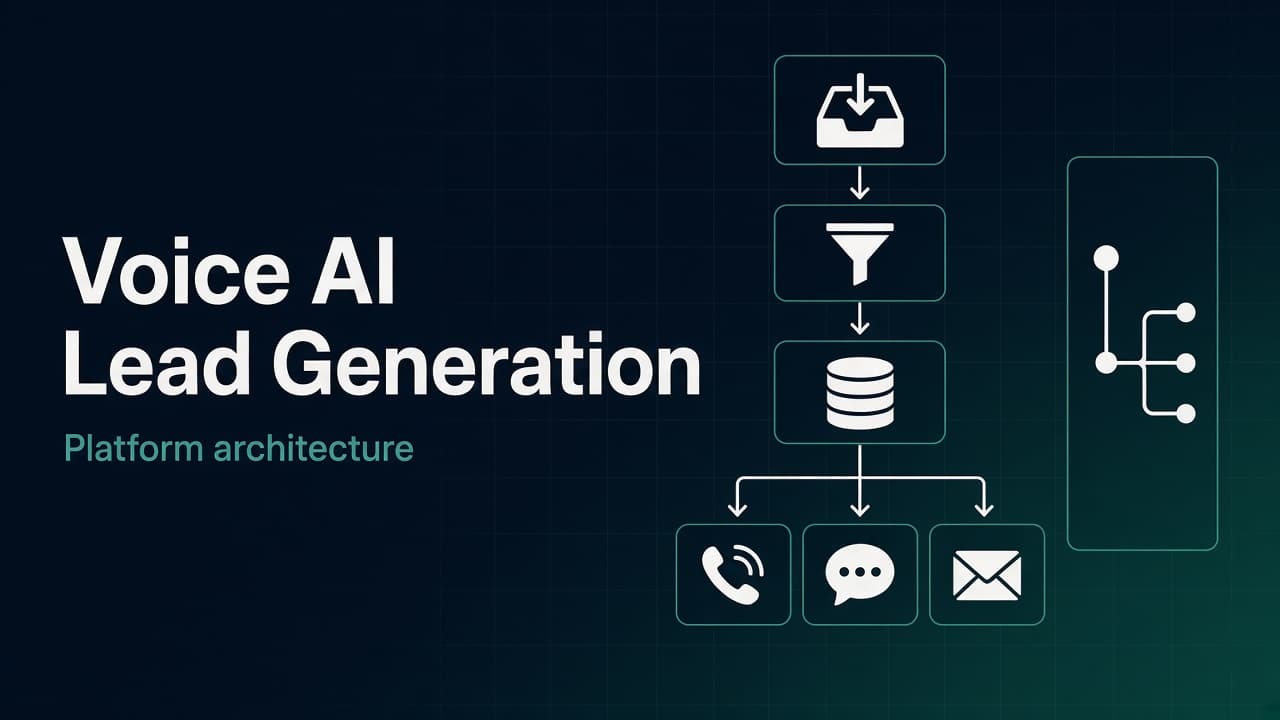
Most lead generation stacks grow by accident: a form tool here, a dialler there, a spreadsheet in between. Add voice AI and several client programmes on the same platform, and the gaps become data leaks and lost leads. This is the architecture I designed for a multi-client voice AI lead generation platform — the components, the tools and the decisions that mattered most.
The use case: one platform, many client programmes
The goal was an end-to-end AI lead generation and customer acquisition platform that runs several enterprise client programmes side by side. Each programme needed its own data, automations and reporting, with strict isolation between them — one client must never see another client’s leads.
The platform had to:
- accept prospect data from many sources and keep it clean and consented;
- engage leads at scale with voice AI agents in several languages, plus WhatsApp, email and SMS;
- bring human sales agents in for high-intent leads, without exposing customers’ phone numbers;
- give every client programme its own dashboards for volume, conversion and cost.
AI lead generation platform architecture diagram
The platform has three data layers — intake, validation and enrichment, and GoHighLevel as the system of record — with an engagement layer on top. n8n sits beside all of them as the only integration path, and security and compliance controls span every layer.
- Web forms & landing pages
- Ad campaign leads
- CSV & partner lists
- APIs & webhooks
- De-duplication
- Phone & email validation
- Data enrichment
- Consent capture
- System of record
- Contacts & pipelines
- Role-scoped access per client
- Activity & call history
- LLM + speech-to-text + text-to-speech
- Multilingual calls
- WhatsApp Business API
- SMS
- VOIP with number masking
- Slack alerts
- Per-client dashboards
- Channel & cost metrics
Core components and tools
Each component has one job. Keeping them separate is what makes it possible to swap a vendor or add a channel without a rebuild.
| Component | What it does | Tools |
|---|---|---|
| Prospect data intake | Brings leads in from every source in one consistent shape. | Web forms and landing pages, ad campaign lead forms, CSV and partner lists, inbound APIs and webhooks |
| Validation & enrichment | Stops bad data before it costs a call: duplicates, invalid numbers, missing consent. | De-duplication rules, phone and email validation services, enrichment APIs, consent records |
| CRM (system of record) | Holds every contact, pipeline and interaction; enforces which team can see which client’s data. | GoHighLevel (GHL), with role-scoped access, custom objects and a high API rate limit |
| Orchestration layer | Connects every component through webhooks and APIs, with logging, retries and replays. | n8n, with one workflow project per client programme |
| Voice AI agents | Outbound and inbound AI calls at scale, in the prospect’s language, writing results back to the CRM. | Vapi with an LLM, speech-to-text and text-to-speech of choice; function calling into n8n |
| Messaging channels | Asynchronous follow-up on the channels prospects actually read. | WhatsApp Business API, email, SMS |
| Human rescue desk | Lets sales agents reach high-intent leads quickly without ever seeing the customer’s real number. | Cloud telephony (VOIP) with number masking and click-to-call, Slack alerts for the desk |
| Reporting & BI | Gives each client programme its own view of volume, conversion and channel cost. | Per-client BI dashboards fed from the CRM and n8n execution logs |
Four architecture decisions that mattered most
No point-to-point integrations
Every connection — intake to CRM, CRM to Vapi, Vapi back to CRM, alerts to Slack — goes through n8n. Adding a channel or swapping a vendor means changing one workflow, not rewiring three systems, and every execution leaves a log you can audit or replay after an outage.
Isolation lives in the CRM, so choose the CRM for it
With GoHighLevel as the system of record, there is no separate per-client database underneath to fall back on. Client isolation comes from the CRM’s access model, mirrored by per-client n8n projects and per-client dashboards. In my evaluation, GoHighLevel’s native multi-tenancy was the deciding criterion — ahead of price and automation features.
Price Voice AI by the all-in minute
Orchestration-style voice platforms advertise a platform fee per minute, but the real cost includes the LLM, speech-to-text and text-to-speech. In my evaluation, Vapi’s advertised $0.05 per minute landed at roughly $0.15–$0.40 per minute all-in, depending on the models chosen. Check concurrency limits and multi-tenant support too, not just price.
Privacy by design, not by policy
Sales agents call leads through masked virtual numbers, so a customer’s real mobile number never appears on an agent’s screen or caller ID. Combined with consent capture at intake and per-client access, that is the foundation for India’s DPDP Act and GDPR for international prospects — confirm each vendor’s data processing agreement before contracting.
Where the AI agents fit
A voice AI agent is still an agent, and it needs a harness. The Vapi agent gets a narrow set of tools — look up the lead, update the CRM, alert the rescue desk — exposed through n8n webhooks rather than direct CRM credentials. Every call is recorded against the lead, so you can review transcripts and tune prompts with evidence instead of guesswork.
The same principles from agent harness engineering apply here: typed tools, least-privilege access, human approval where the stakes are high, and tracing on every run. For multi-step agent logic beyond a single call, see agentic AI systems architecture with LangGraph; for adding LLM features to existing services, see integrating LLMs into enterprise microservices.
Frequently asked questions
What is an AI lead generation platform?
An AI lead generation platform collects prospect data, validates and enriches it, stores it in a CRM and engages each lead automatically through voice AI agents, WhatsApp, email and SMS, bringing in human sales agents when a lead is ready. The AI handles volume and speed; people handle the conversations that close.
Why use n8n to orchestrate a lead generation platform?
n8n connects the CRM, voice AI, messaging and alerting tools through webhooks and APIs without point-to-point integrations. Every execution is logged and can be replayed, workflows can be separated per client, and it can be self-hosted when data residency matters.
Can voice AI agents replace sales teams?
Not for closing. Voice AI agents are good at high-volume, repetitive conversations in many languages, at any hour. The best results come from pairing them with a human desk that takes over high-intent leads, so paid human time is spent where it converts.
How do you keep each client’s data separate on one platform?
Make isolation explicit at every layer: role-scoped access per client in the CRM, a separate n8n workflow project per client, separate dashboards in the BI layer and masked numbers for calls. Pick a CRM with strong native multi-tenancy, because there is no database-level isolation underneath to fall back on.